
Talking Shaping, Tools, and The Pursuit of Speed With Maurice Cole

Updated: Dec 2, 2025

This autumn legendary surfboard shaper Maurice Cole was back in Cornwall at the Cord factory as part of a European shaping tour. As Maurice’s licensed shaping partner for the UK it’s always great to host him here. He shaped a bunch of special custom orders, discussed new designs with head shaper Markie Lascelles, and held court in the shaping bay. We took the opportunity to turn the mic on Maurice, and asked him three questions about shaping, the machine versus hand-shaped debate, and the pursuit of speed:
Maurice, how much of your shaping these days is intuition versus embedded patterns?
That’s a bloody good question. I’m a gut-feel shaper. I’ll always look at things, and can see things, and because of all of the boards that I’ve done, everything from eleven foot guns for Nazaré or Jaws to small kids’ boards, and everything in-between, I’ve got a lot of experience to draw on.

Back when we had to shape from a raw blank, you had to conceptualise what you wanted the board to do, then you had to visualise what it looked like, and then you picked your planer up and went hand-shaping. I used to like to shape a board over a period of time, so I’d spend the first day just doing the templates, cut the top and bottom, and rough it out. The second day, I would bring it down to a pre-shape, just block everything out and get it just right. Then on the third day I’d finish it. In that period of time I would see all sorts of different things, from different angles, and be thinking, “if that happens or this happens then it’ll do this.” Just constant questions. As a designer it never ends. All of that experience feeds into how I shape boards now.

When I saw a customer just now and saw what he was riding and measured it, I knew I needed to move the fins back, do this and that, “I’m gonna make you an 8’0”, and so on. That’s sort of intuition but it’s based on all of that accrued experience and being able to understand what he’s talking about and what he wants and needs. And that’s the difference between a stock surfboard and a custom.

So far on this trip I reckon I’ve spent ten hours talking to customers, and I’ve nearly done two hours shaping. It’s to get it right.
I don’t do big numbers and I don’t ever want to do big numbers. I like doing smaller numbers and I like nailing a brief. Once upon a time Ross Clarke-Jones said “I want to ride eight to eighty feet, and I want a 5’9”. It took three years to perfect that tow board for him, but we got there.
I’m a really technical designer and shaper. There’s nothing on my boards that’s done for the look. I worry about the look after. Every little thing that I do has a technical reason.
When I try and work out what that intuition is, for me it’s a bit of gut feel, and what’s gut feel? It’s experience, but it’s also having the ability to translate everything that I see and do into which model, because I have so many different designs. It’s a technical thing, but at the end of the day if I’m shaping a board and there’s a little something I don’t like, I’ll adjust it, and I may not know why a that point, or really think about it too much. It’s just my gut feel and intuition, and it might not make a difference but it’d drive me nuts to leave it like that.
You’ve been a proponent of using machines as a tool…
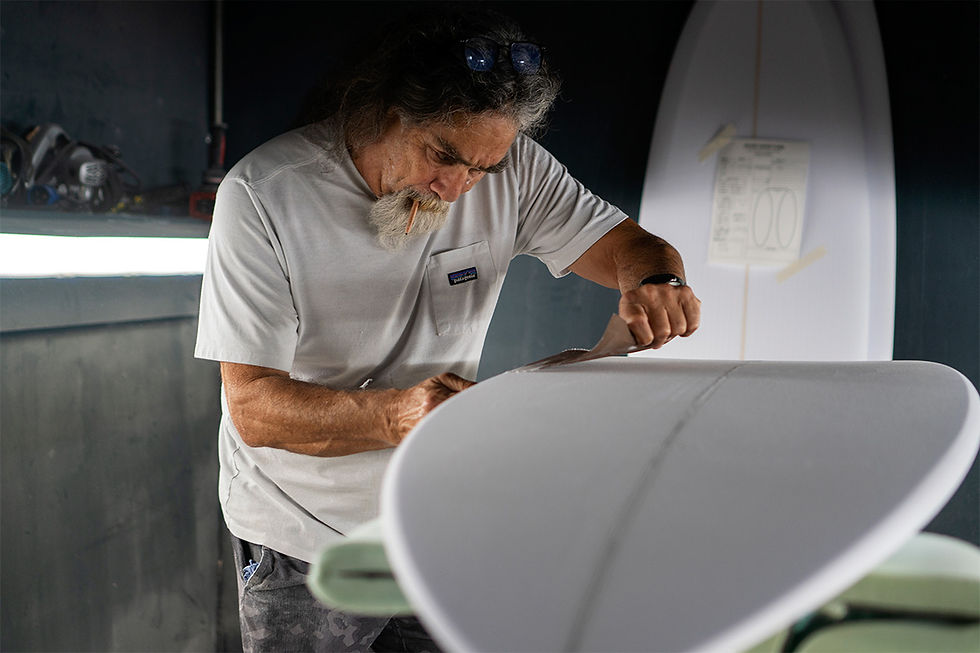
I’m a designer. I don’t think I’m a very good shaper. As far as a craftsman and a pair of hands on a planer, I reckon I’m in the bottom 10% in the world but the difference with me is I’m a good designer. The machines have allowed somebody like me, who is not so great or fast with a skil plane, to shape enough boards to make a living. It’s just a tool.

I hear all the debates about difference between hand shapes and machine shapes and everything like that… Good for you if you can make a living shaping by hand, but I can’t do it at my age – I’ve had a shoulder reconstruction, I’ve got all sorts of physical ailments where I can’t do as many boards as I used to. And shaping down a big blank? All you’re doing is trying to get it to a pre-shape. When I discussed how I used to shape a board over three days, the machine has eliminated day one and two. I can shape a lot more surfboards using a machine to cut pre-shapes, whereas before I’d be lucky to do five a week. I’d just be walking up and down a room making a lot of dust and end up with a blown-out shoulder.
The machine is a tool just like a block plane is a tool. And imagine if a car designer had to hand-build every car? There’d only be fifty new cars a year.
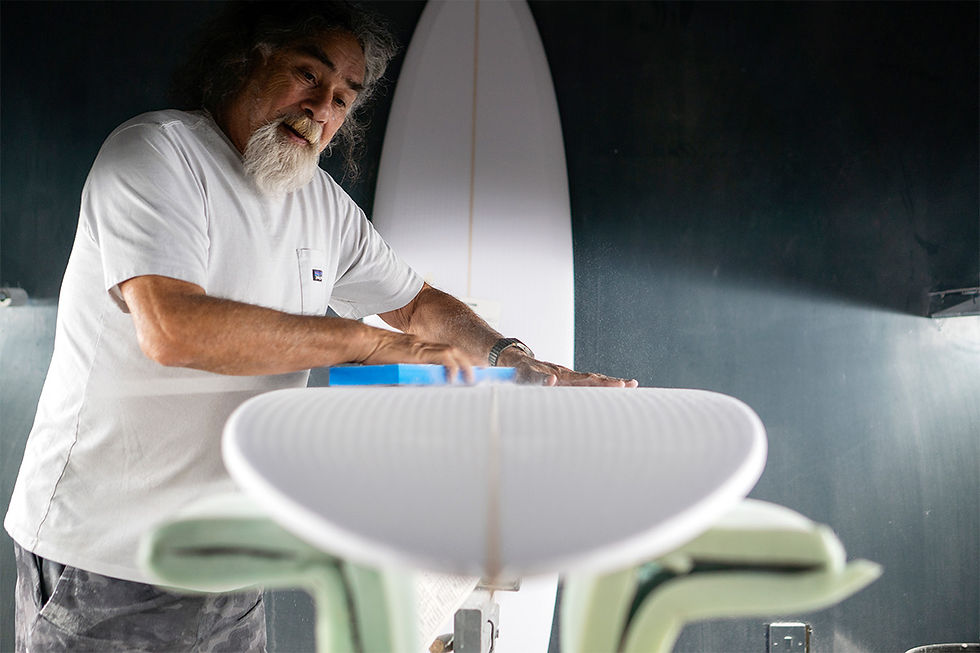
Sometimes when people have had a go at me about machines and hand shaping, I point out that maybe they’re hand shaping because they haven’t got enough work. And when they’ve got enough work? They’ll switch to a machine. They say they’ll never will. But that’s until they get a sore elbow. And then it goes to their shoulder. And then it turns up in their wrist and they’re starting to get RSI. And then one day they’ll go to take off and their right arm won’t work and their face hits the board. I’ve been there and done it.

You’ve previously mentioned designing a board to go fast. Is speed the end goal?
Well, good question, and an easy question. If we’re able to be doing 30 km/h on a surfboard right now, in the future, do you think we’ll be going faster or slower?
To go back, twenty years ago we were topping out at 25 km/h to 30 km/h on a modern shortboard. We’re now getting to 32/33 km/h. These new V-Con threes that I’m making, one’s been clocked at Bells, just an average guy surfing, at 38 km/h. That sort of speed means making sections and having speed to play with.
The whole idea, and this is what I’ve always thought for pros, is that if you can get a board that goes faster, would that mean that instead of doing one, two, three turns, you might be able to go one, two, three, and then do a fourth? Which means that if you can get in four manoeuvres on a wave compared to three, the chances are that you’ll beat the guy who only did three. The whole idea is to be able to go that fast, but to go that fast there can’t be any breaks. The minute a board slides or breaks and loses speed then you’ve got to stop, start, and re-go again. But when you look at John John, or you look at the top guys on their backhand especially, where they can engage the whole rail, it’s just one fluid turn after another and it all joins up. The idea is having a faster board that carves.
That’s why on the tow boards we’re doing 60. It hurts my legs though! We’ve learnt that on tow boards the faster that we can go, we can get down to the bottom of the waves and we can outrun the lips, so we’re going faster than the wave. If you’re not doing that then you’re just going to the channel in a straight line.
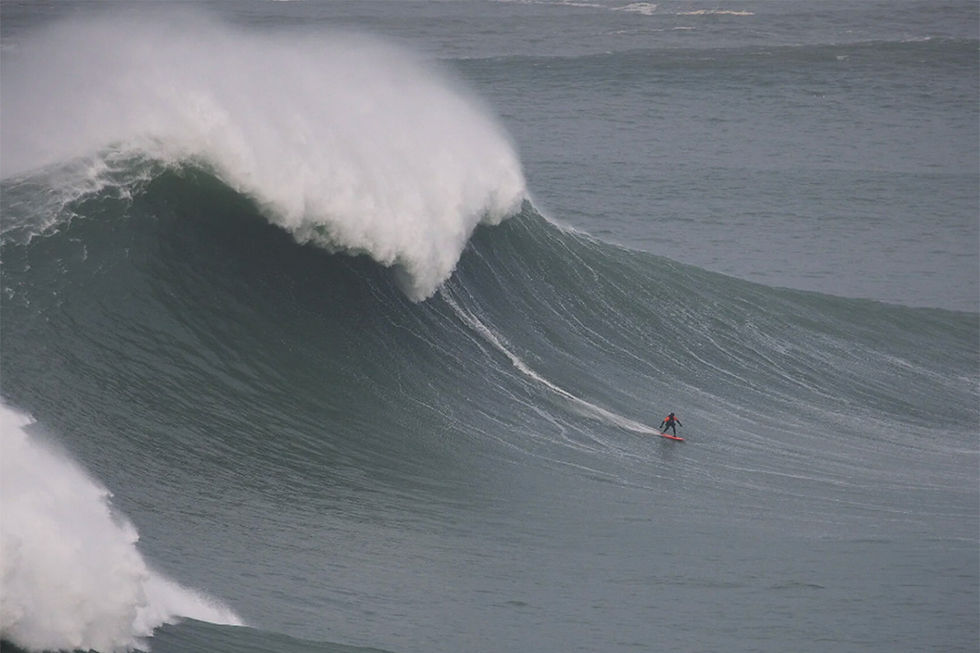
If I was looking into the future, I’d say let’s go faster and do more manoeuvres, but how? That’s where my thinking is currently at.
With my tow boards I’ve got really deep concaves and they’re going that fast, but they’re limited in choppy waves, and strong offshore waves. The concaves don’t like it. That’s why I’ve gone to a reverse vee up front. I use the concave at the tail for squirt and the turning part of the board, and then you jump onto your front foot and it just cuts through the chop and the offshores. It’s combining concaves with the reverse vee, that’s where my boards are at now. Ask anybody who’s got my boards and they’ll tell you that they’re fast – to the point where the surfer will usually have to adjust their turns.
When I first made a really deep concave tow board, I went to lean on it and push, it was that damn quick, I don’t know many times I went off the back as the board accelerated, until I learned to change my surfing. The problem was that I changed my surfing to adjust to a faster board, and when you go back on to a slower board, it just feels like shit!

Maurice Cole’s designs are available in the UK through us here at Cord Surfboards, made from start to finish in our factory to Maurice’s exacting standards.


Comments