
How and Why We Made The Otter – Our Latest Channel-Bottom Twin Fin Surfboard


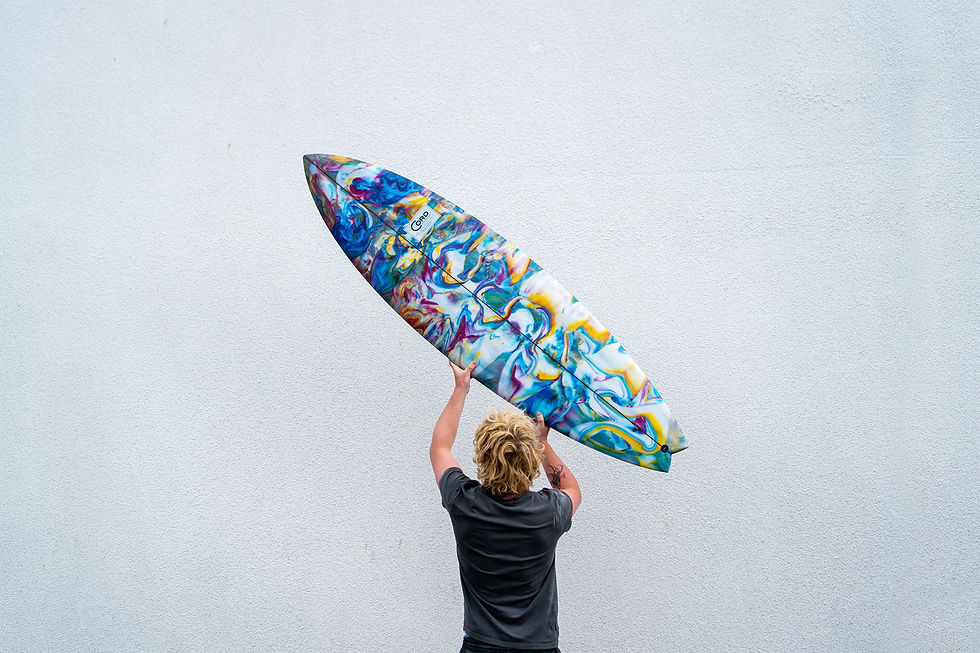
It’s time to officially launch our new Otter model into the world - an all-round good wave twin fin that performs right through the range of waves from regular to well-overhead and hollow. If you keep an eye on our socials then you can’t fail to have missed this board over the last year and a half, as it’s been the model on which Markie and the team have scored so many good waves through the course of its development and refinement.

The Otter is now available to order on our website in stock sizes from 5’10 (30L) to 6’8” (39.5L), and is tried and tested in waves from Ireland to Indo.
On the drive back from his latest Ireland strike mission, head shaper Markie Lascelles finally found a moment to share his thoughts on how the Otter came to be, and why you need one in your quiver:

How did the Otter model come about – was it because of a need for a board to perform in certain ways or waves, or was it the result of constant design refinements and tinkering with an existing model?
The main reason for me was the success of the Ark, our channel bottom twin pin. That model’s been massive and people love it, myself included. But it’s designed primarily for slabs - getting in early, making the drop and running through the tube - so I’ve always found its limitations of being a little bit flat and wide in the nose for me, which can make it a bit catchy, depending on the wave. I wanted to make something with a narrower outline, more shortboardy, more like a step-up, but keeping the volume up the front which is why the Otter has the beaked nose. Also, as a designer, just to change things up a bit – something visually different, something that surfs a bit tighter in the pocket.
I guess everyone’s doing a twin pin now so I wanted to move it on a bit and do something slightly different.
What did you design the Otter to do?
I designed the Otter to surf fast and paddle well. I wanted it to be good for tubes, but then when you lay it over on rail I wanted it to feel really trust-worthy. Like, almost shortboardy, but faster, and a better paddler than my normal shortboard. Which is again where it differs from the Ark - there’s a lot more rocker in the Otter, it’s tighter in the tail block, and has a narrower outline. It’s designed almost exclusively for better waves because of that increased rocker and a narrower outline, whereas the Ark will go in pretty much anything.
How else does it differ from the Ark model, in both design features and performance characteristics?
With the swallow tail I’ve always felt you can ride it a tiny bit shorter too, because you have that length of rail line. And it’s just something different – everyone’s got slightly different styles and needs help in slightly different areas. I feel like with both of those boards you hit every side of the market. And we’re having a lot of success with one without channels now, which Connor, Alex Libby and I have just been testing… that was the one I rode all season this year in Indo. It’s lots of fun.

Which team riders fed into the design development and testing process?
Over the course of the R&D of this board, pretty much everyone on the team helped me with feedback. I originally made it for Noah, and he had huge success on it, then I made myself one, then Arthur, Isaac, and Connor. Connor’s just asked for a 6’6” version as well as a 5’8” so it seems to be a real winner across the range.
This model went through some solid testing, with multiple sessions in Ireland and Indonesia going down before you finalised it as a model. Is that process more critical than ever because of the types of waves this model has been designed to perform in? And how does that R&D process work for you – what are you feeling out with a new model, and what questions and feedback are you asking from team riders?
I wouldn’t say it’s more critical to test a board more if it’s for more serious waves. I think my design process is a maybe a bit too drawn out. I’m a bit like a Labrador, I get a too excited about what a design is doing and what I can change next and I keep fiddling about with it.
But when it comes to testing, you’ve got to trust the board that you’re making to get you the waves that you want to get. I never make something if I don’t think it’s going to improve my chances of making those waves. So I’d say if anything, the more I learn and the longer I do this, the better I get, and the better waves I get because the boards are better and they’re helping me in the areas that I’m struggling in. That’s basically what I’m trying to do – eradicate my inability and my weaknesses, via the surfboard!
I want the surfboard to do the hard work, so I don’t have to, is the dream.

Everything has the same design and testing pathway, for me, which is it gets born in my head from ideas or past models, or new feelings that I want to get. That goes out to the team (and they normally cut me down on it!) and then we really get into the detail and finalising of it and keep developing from there.
Did this design surprise you in any way?
No, not really. I felt like when I shaped the first one I knew that it was going to be a good board. You know enough things when you get to my position that you’re aware when you’ve taken a big gamble and it’s something completely different and it might surprise you, versus when you’re designing a board by assembling tried and tested design elements of the things that you like and know that they’re normally pretty safe and sure-fire.
What’s been your most memorable wave on an Otter, to date?
My most memorable wave would probably be on the first version of it. I got a pretty sick one at HT’s… well, we had a pretty sick three weeks there to be honest. And one at Greenbush. That whole trip was the first time taking the Otter away, and that’s where it got its name because I was slipping around the lineup in a borrowed impact vest like a little otter.


Comments